
Space based manufacturing
a summary of fascinating things I consumed this week.

Dispatch Space emerges from Stealth to build factories in orbit :
This week, Y Combinator-backed startup Dispatch publicly revealed its plans to build the infrastructure layer for space manufacturing : permanent uncrewed factories in orbit paired with reusable vehicles that bring products back to Earth.
Similar manufacturing systems have already been demonstrated on the ISS, but costs remain prohibitively high.
The microgravity environment is perfect for manufacturing certain pharmaceuticals, semiconductors, biorpinting tissues, etc.
The company plans to launch mid 2027.

(image of them testing their satellite prototype)
Anthropic Launches Claude tag
This week, Anthropic launched Claude Tag, allowing users to bring Claude directly into Slack conversations as a persistent AI teammate rather than a separate chatbot.
The product itself is less interesting than what it signals. For the past two years, dozens of startups have been raising money to build AI coworkers.
This reflects a broader trend in venture capital: investors are becoming increasingly skeptical of AI wrappers and increasingly interested in companies with proprietary data, unique workflows, or deep domain expertise. If OpenAI, Anthropic, or Google can add your core feature in a product update, your moat may not be strong enough.
As frontier labs continue moving up the stack, founders may need to focus less on generic AI assistants and more on solving specific industry problems that large model providers are unlikely to tackle directly.
GLM 5.2 Pushes Close to the Frontier at Fractional Cost
This week, Chinese AI lab Z.ai released GLM-5.2, a frontier-scale open-weight model with a one-million-token context window under an MIT-style license, making it freely downloadable and modifiable.
The model reportedly matches or exceeds GPT-5.5-level systems on several long-horizon coding and agentic benchmarks while operating at significantly lower inference cost. Its efficiency comes from a mixture-of-experts architecture, where only a small subset of its ~hundreds of billions of parameters activate per token, keeping compute requirements closer to a much smaller model.
It also uses sparse attention techniques that allow extremely long context windows without linear cost explosion, making it useful for large codebases, research documents, and multi-step agent workflows. Training was additionally optimized around agentic tasks, where the model iteratively writes, tests, and debugs its own outputs.
The broader signal is less about one model and more about trajectory: frontier-level performance is increasingly appearing in open systems, compressing the gap between closed proprietary models and widely available alternatives.
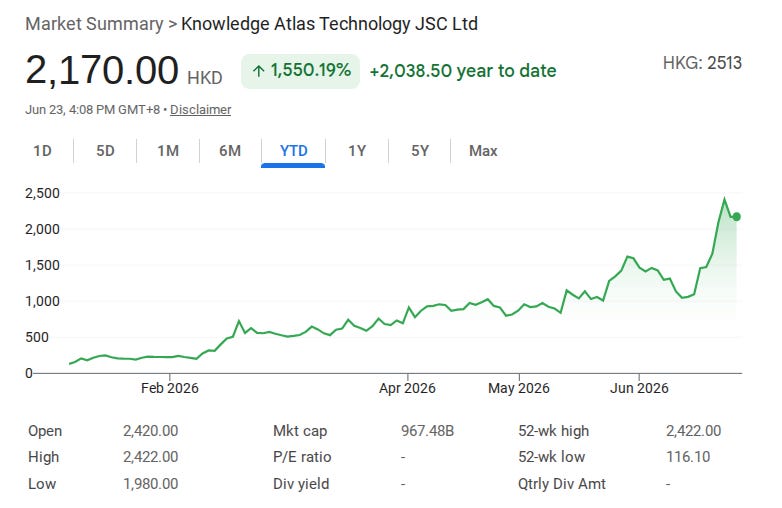
(Z.ai stock YTD on hong Kong stock exchange)
Colossal Biosciences valued at 10 billion
Colossal Biosciences is continuing to scale its de-extinction platform, with recent funding pushing its valuation above the multi-billion-dollar range as it expands efforts to revive extinct species like the woolly mammoth and other Pleistocene-era animals.
The company is combining ancient DNA reconstruction, CRISPR-based genome editing, and synthetic biology techniques to engineer proxy species that resemble extinct organisms rather than perfectly restoring them. Initial milestones focus on gene edits in elephant cells and mammoth-like traits such as cold tolerance and altered fat distribution.
While full de-extinction remains far from reality, the bigger shift is that investors are now treating synthetic conservation as a legitimate biotech category rather than speculative science. This places Colossal at the intersection of conservation biology, synthetic genomics, and platform biotech.
The broader implication is that biology startups are increasingly moving from treating disease to actively redesigning ecosystems and species themselves, a shift that could redefine what “biotech” even means over the next decade.
(deep dive on colossal and de-extinction tech coming soon - subscribe to stay updated)
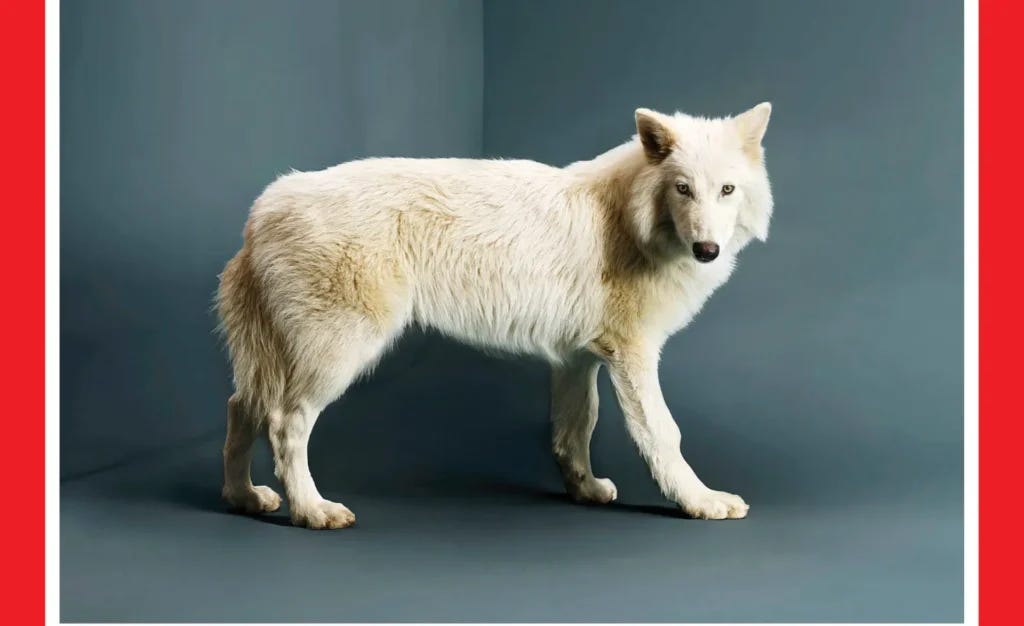
(de-extincted dire wolf)
Other links
agent loops - blog
meta is working on a prediction market - NYT
when will Sonnet 5 release - WaveSpeedAI