
Analysis : Industrial Biomanufacturing
Excitement around biomanufacturing is high, but will the field actually deliver results, and when?

We are reaching the limits of how we make things.
For over a century, industry has relied on heat, chemicals, and fossil fuels. But what if we could manufacture materials the same way we brew beer?
That is the promise of biomanufacturing. By treating biology as an engineering discipline, scientists are programming cells to produce chemicals, medicines, foods, and materials more efficiently—and sometimes create entirely new ones.
This shift is already underway. McKinsey estimates the bioeconomy could generate up to $4 trillion in annual economic impact, and the rapid scale-up of mRNA vaccines showed what biological manufacturing can achieve.
But scaling biology is hard.
Moving an engineered microbe from a lab bench to a 100,000-liter bioreactor remains one of the toughest challenges in modern engineering. The industry faces major bottlenecks in fermentation capacity, and many highly funded startups have failed to make the economics work.
To understand where biomanufacturing is actually headed, we need to look beyond the hype and examine the science, economics, and infrastructure driving the field.
In this deep dive, we’ll cover:
• How humanity evolved from ancient fermentation to modern synthetic biology.
• Why fermentation is only one piece of the biomanufacturing landscape, alongside pharming and chemoenzymatic processes.
• The lessons of the 2010s biofuels boom and bust.
• The companies turning biological manufacturing into products people can buy today.
How we got to modern biomanufacturing
Long before humans understood the concept of a cell, let alone DNA, we were already running biomanufacturing plants.
Every time an ancient civilization brewed beer, baked leavened bread, or fermented cheese, they were using living organisms as biological factories.
We can consider this the 0th stage of biomanufacturing.
The transition from kitchen craft to industrial science began in the late 19th and early 20th centuries.
Louis Pasteur demonstrated that fermentation was caused by living microbes, not chemical decay. This shifted the industry from guesswork to controlled microbiology.
during the 1940s, scientists realized they could use fermentation to produce penicillin and acetone, driven by huge demand, these were the first industrial scale bioreactors (basically tanks filled with bacteria)
This design choice still influences modern biomanufacturing (not always in a good way)
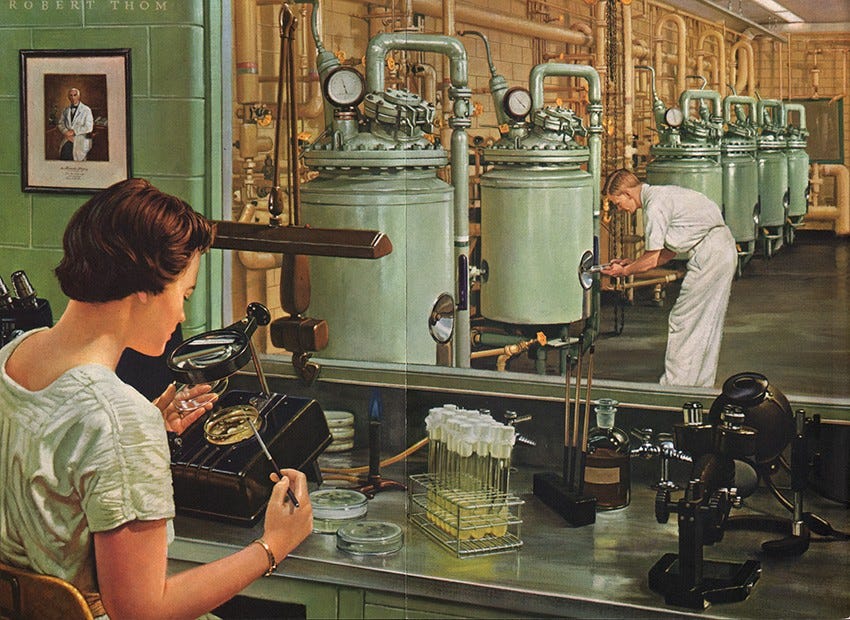
This was the 1st phase of biomanufacturing.
The real paradigm shift occurred in 1973, when Herbert Boyer and Stanley Cohen successfully transferred a gene from one bacterium to another, inventing recombinant DNA technology.
In 1978, Genentech used this breakthrough to produce synthetic human insulin. Before this, insulin had to be painstakingly extracted from the pancreas glands of millions of slaughtered pigs and cows, which frequently caused allergic reactions in patients. By turning bacteria into insulin factories, Genentech proved that programmed biology could outscale and outperform traditional chemical and agricultural extraction. Again, using bioreactors to grow and produce the insulin.
We can consider this phase the 2nd phase of biomanufacturing.
We are now entering the 3rd jump, which is very similar to how computing exploded in the 80s and 90s. This phase started roughly 20 years ago, Technologies critical to biomanufacturing will collapse, and the cost curve for starting a biomanufacturing company will rapidly slope downwards.
At the same time, we will shift away from big steel tanks to alternative hardware for manufacturing. In this phase biomanufacturing will explode from a method used to make niche products, to a broad manufacturing method.
How the 3rd generation of biomanufacturing will work
the third generation of biomanufacturing will ultimately have 2 major characteristics.
it will be accelerated by crashing costs for biotech
it will involve a diversification of the manufacturing hardware away from big tanks
In this section we will look at which technologies are reducing in cost and how it will help, and what will be used in replacement of traditional bioreactors.
cost curves
AI driven design
Lets imagine you are attempting to manufacture chemical A, and so you are trying to find a protein B that will stick to the precursor of Chemical A (we will call this precursor X). historically you would likely try to read literature and studies to guess what proteins might be able to stick to precurosor X and turn it into Chemical A. After picking 100s or 1000s of proteins, you might use very simple protein docking simulations to narrow it down to a few thousand or a few hundred targets. then you would manually test each one.
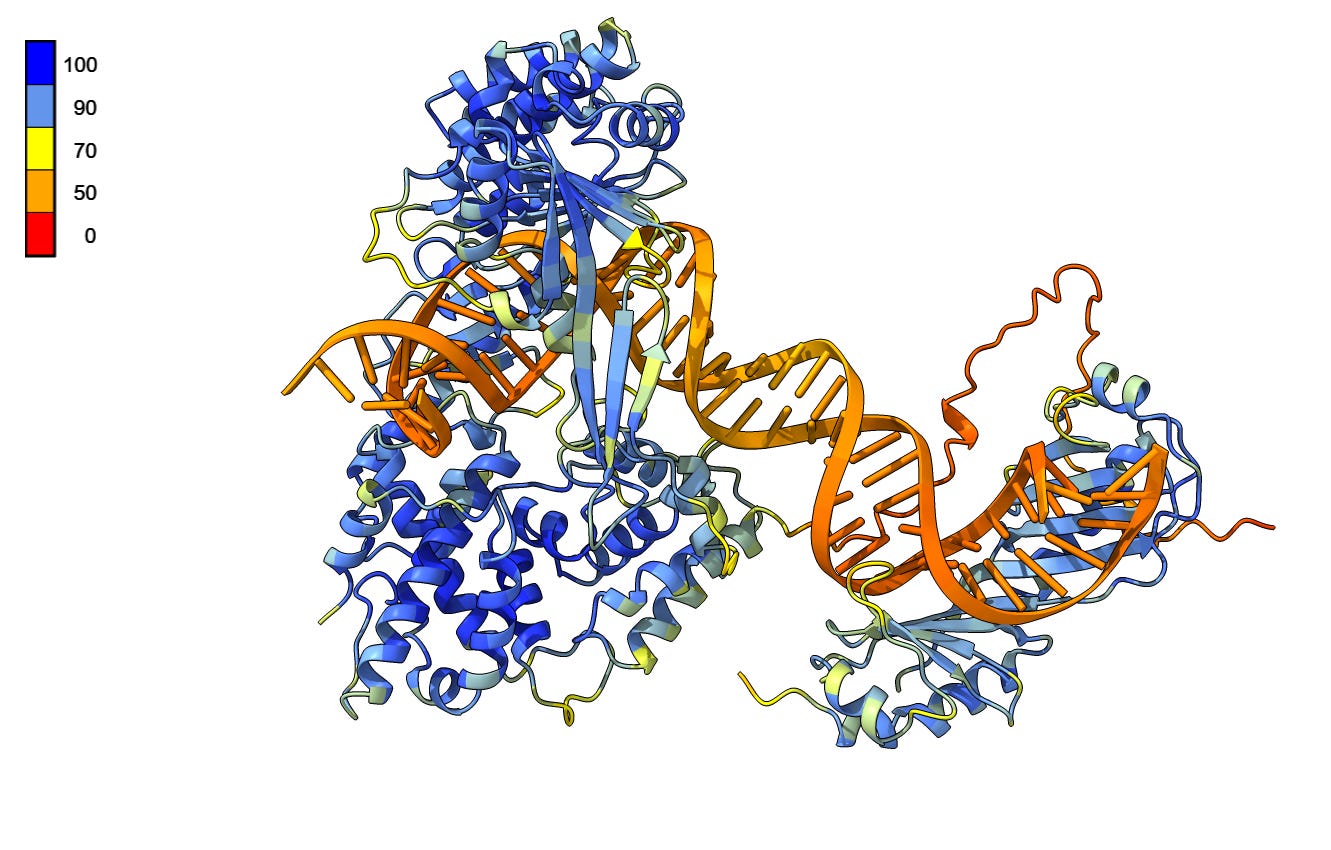
However with AI driven design, you would simply take all of your targets and then enter their amino acid sequences into an AI model like alphafold3. Then this model will actually take the list of aminoa cids and predict what the proteins 3d structure will be. Other AIxBIO models can predict whether or not your protein will bind to others, what metabolic paths it will be involved in, etc.
This will allow companies to entirely skip large parts of the discover process, IN addition some models can actually design compeltly new biological components, that aren’t present anywhere in nature, this can unlock huge potential for biomanufacturing.
Synthesis costs
DNA synthesis is the core technology that enables biomanufacturing, it contains the actual isntructions for producing a material. Virtually every kind of biomanufacturing requires DNA synthesis at spome stage of development. The cost of synthesis is rapidly collapsing and this will also collapse costs for many biotech companies.
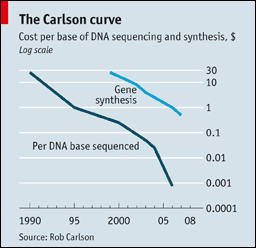
Its important to note however, that gene synthesis is still quite expensive, and out of these 3 cost curve technologies, this is likely the one that will take the longest to actually collapse. (likely via enzymatic DNA synthesis)
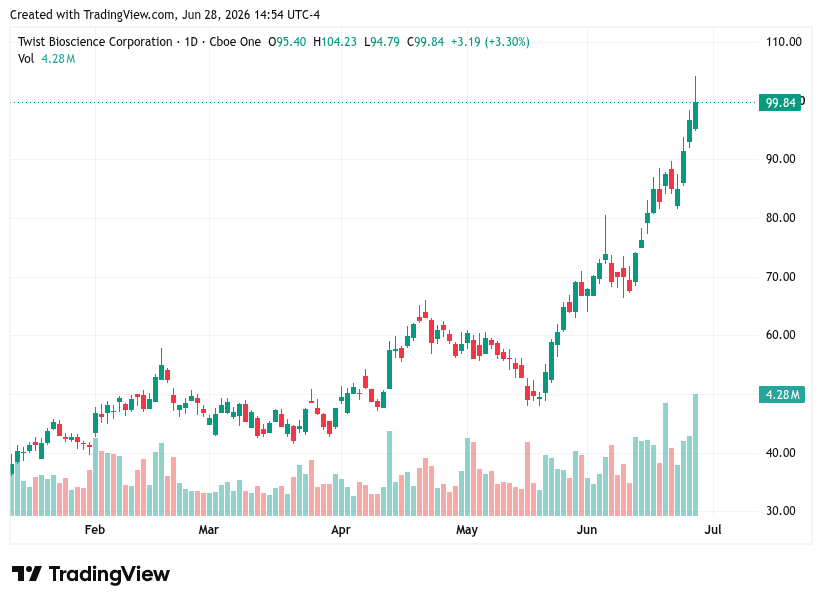
(TWST biosciences a popular silicon based DNA synthesis vendors stock YTD)
Lab Automation
today roughly 10% of a biomanufacturing companies costs can be attributed to paying technicians to complete simple, relatively manual work in a lab. Around 30% of a biomanufacturing companies costs is labor costs overall.
Companies like Opentrons are already starting to build systems to automate labs, and these systems are rapidly becoming cheap enough for most companies to afford.
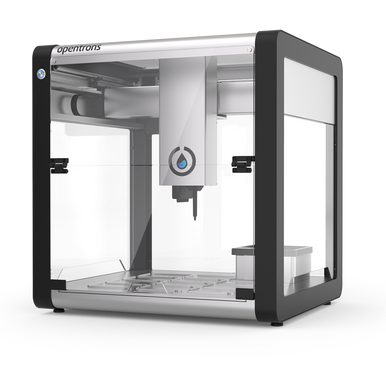
AI agents also have high potential to replace more complex jobs that require more knowledge and experience. Companies like Gingko Biosciences have teamed up with OpenAI, using robots+AI agents to run fully automate dlabs, and they have seen relatively good results.
Moving past fermentation + tanks
Historically in order to biomanufacture, the target chemical that needs to be manufactured has the DNA sequence coding for it, inserted dinto either bacteria or yeast. Then these organism are placed in large steel tanks, where sugar is added and condition are carefully monitored. The microorganism release the target protein, and then machines are used to purify the product.
This works great for making things like insulin, but for biomanufacturing to become a major source of materials, it needs to branch out. Below are a few of the most promising, novel biomanufacturing methods.
Cell Free biomanufacturing
Cell free biomanufacturing removes the cell entirely, in a cell generally the DNA → RNA → target protein that’s being manufactured. What cell free biomanufacturing does is it removes anything that isn’t involve dint hsi process such a s the cell membrane. This purification makes cell free systems expensive, but this cost will come down, in addition cell free biomanufacturing does not require a lab to run, just DNA and the cell free powder, which allows for on point manufacturing (don’t ened a factiory, can be made where needed with a tube).
Chemoenzymatic cascades
Currently, biomanufacturing is really only used to make biological chemicals. things like insulin, drugs, etc. Traditional, industrial, non biological chemicals are usually made using petrochemical processes. These involve using precursors along with huge amounts of heat, pressure, and often toxic chemicals to manufacture.
What chemoenzymatic procceser due is simple, the steps of making a chemical that just involve a simple, clean, chemical reaction are kept. But steps that involve huge amounts of heat, or expensive and toxic chemicals, are replaced with enzymes (proteins that can catalyze reactions).
Pharming
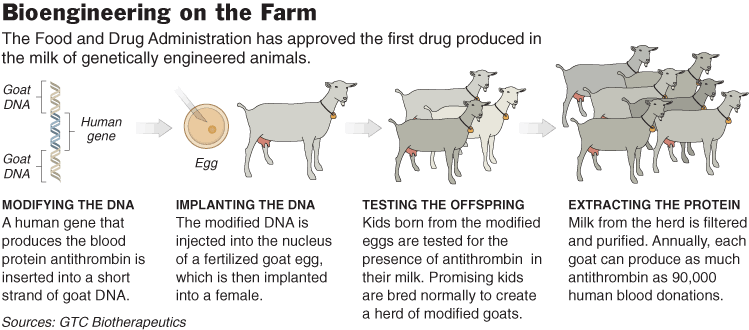
traditionally the organisms used for producing the target chemical/material are microorganism like bacteria and yeast. However the issue with these is they require expensive bioreactors, align with feedstock and nutrients. An alternative to make this cheaper, is instead inserting the same genes for the target chemical into a Plant or Animal. To give you an example, a certain drug is manufactured using goats, the DNA is inserted into the goats genome (harmless, does not hurt the goat in any way), this results in the target chemical being produced in the goats milk and then can be purified.
Carbon Waste
another change in technology could be changing the actual source of energy and materials. In a bacterial or yeast absed biomanufacturing system, sugar + nutrients are usually used to feed the organism, with carbon feedstock system, carbon is used instead, often with organisms like algae. This way the manufacturing system is carbon negative and in some cases cheaper.
Past Failures
Amyris
Amyris was founded in 2003, early on they attempted to use genetically modified bacteria to produce precursors for anti-malarial drugs. This business was successful, and as a result they went public on NASDAQ, this si when they made their biggest mistake. They chose to attempt to produce renewable diesel and jet fuel, however scaling up bioreactors is not easy, humans have spent 100s of years figuring out how to get oil out of the ground as cheaply as possible. Afterwards Amyris tried to make consumer products such as Squalene (derived from sharks, used in cosmetics), however the company never managed to actually live up too its promises, and went bankrupt and then restructred.
Zymergen
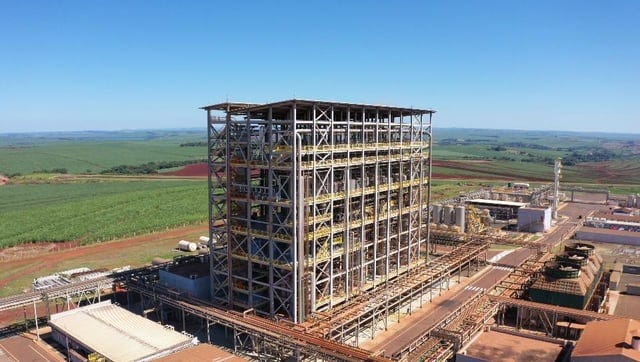
Zymergen was founded in 2013, early on they attempted to use machine learning and robotics to automate the discovery of new microbes for industrial materials. This business pitch was wildly successful at attracting venture capital, and as a result they went public on NASDAQ with a multi-billion dollar valuation, this is when they made their biggest mistake. They chose to attempt to produce a bio-engineered optical film called Hyaline for flexible smartphone screens, however scaling up bioreactors is not easy, and convincing electronics giants to change their hardware supply chains is even harder. Just four months after their IPO, Zymergen had to admit the material faced severe technical scaling issues and would make zero revenue, causing their stock to crash 70% in one day. The company never managed to actually live up to its promises, and was eventually bought out by Ginkgo Bioworks for pennies on the dollar.
Lessons
bioreactors + GMO bacteria are only suitable for producing high value, smaller scale commodities (drugs)
In order to scale into other types of materials and chemicals, we must use alternative biomanufacturing methods
Stay away from synthetic Biology companies, unless the unit economics are strong at a small scale, this way if the technology fails to scale, the company can still be profitable.
Current succeses
Solugen
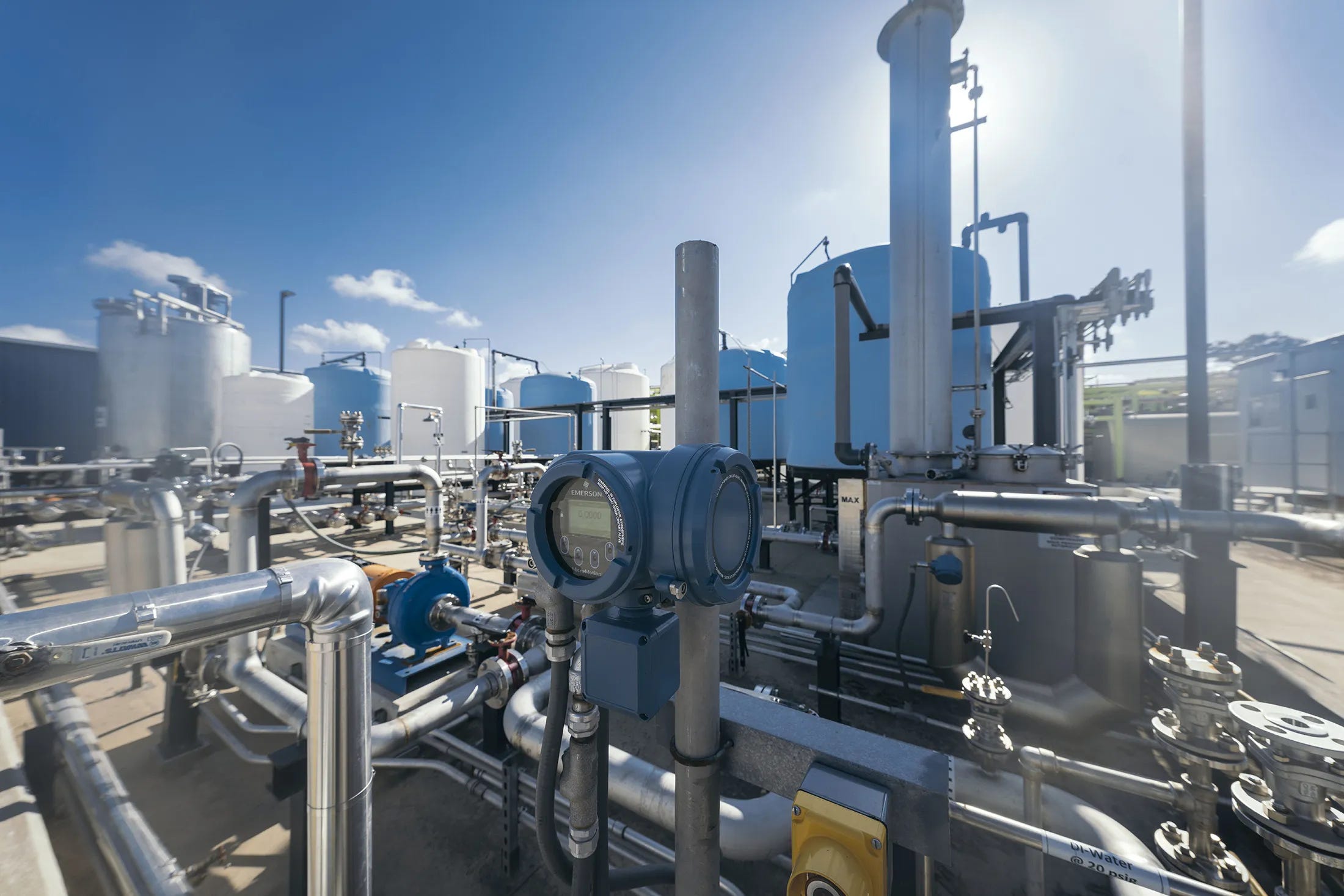
Solugen was founded in 2016, early on they used an engineered enzyme to produce bio-based hydrogen peroxide for wipes. This business was successful, and they raised hundreds of millions of dollars, which is when they made their smartest strategic choice. Instead of using living microbes in giant fermentation tanks, they combined pure enzymes with metal catalysts in a cell-free system called the Bioforge. This approach bypassed the scaling bottlenecks that broke previous biotech startups, allowing them to make chemicals with zero waste. Afterwards, Solugen expanded to a massive plant in Minnesota, hit a billion-dollar valuation, and proved that biology can actually compete with fossil fuels. (as long as you use the right method)
Pivot Bio
Pivot Bio was founded in 2011, early on they used gene-editing to create microbes that replace chemical nitrogen fertilizer for corn crops. This business was successful, and they deployed their product across millions of acres of American farmland, which is when they made their smartest strategic choice. Instead of trying to manufacture bulk chemicals inside a factory, they engineered microbes that grow directly on plant roots in the soil, using the crop itself as the environment. This approach bypassed the massive capital costs of building traditional chemical plants, allowing them to scale through existing seed distribution networks. Afterwards, Pivot Bio raised hundreds of millions of dollars, hit a multi-billion dollar valuation, and proved biological farming can displace fossil-fuel fertilizers.
Future outlook + timelines
2026–2028
│
├─ Manufacturing becomes biotech’s primary bottleneck.
├─ Investors shift capital toward fermentation, scale-up, and infrastructure.
├─ AI-driven strain engineering becomes standard.
└─ a16z argues many products remain uneconomic below ~$10/kg production costs.
2028–2032
│
├─ Biology foundries and contract manufacturing platforms expand.
├─ Startups increasingly adopt a “fabless biotech” model.
├─ New bioreactor designs reduce scale-up costs.
└─ Infrastructure investment outpaces investment in individual products.
2032–2037
│
├─ Specialty chemicals become economically competitive.
├─ Biomaterials and industrial enzymes scale into major markets.
├─ Cost and manufacturing efficiency become the key competitive advantage.
└─ Biology is increasingly viewed as an industrial platform, not just healthcare.
2037–2045
│
├─ Biological production competes with portions of petrochemical manufacturing.
├─ Large-scale biofactories become critical industrial assets.
├─ Governments begin treating biomanufacturing as strategic infrastructure.
└─ Automation dramatically lowers development and production costs.
2045+
│
├─ Biology becomes a general-purpose manufacturing technology.
├─ Large fractions of chemicals, materials, and food ingredients are biologically produced.
├─ Factory deployment becomes more important than organism engineering.
└─ The bioeconomy increasingly resembles traditional industrial manufacturing.
──────────────────────────
KEY FORECASTS
────────────────────────────
McKinsey (2020)
• Biological applications could create $2–4 trillion in annual economic impact over the next 10–20 years.
Andreessen Horowitz
• Current fermentation economics struggle below ~$10/kg products.
• To account for scale-up risk, products ideally exceed ~$100/kg.
• The largest opportunity in synthetic biology is reducing manufacturing costs rather than improving genetic engineering.
McKinsey Future Arenas (2024)
• Industrial and consumer biotechnology could become a $340–900 billion annual industry by 2040.
Investor Consensus
• The next decade’s winners are likely to be companies that lower the cost of biomanufacturing rather than companies that simply create new organisms.
Conclusion
While the exact timeline remains uncertain, the direction is clear. Investors increasingly view biomanufacturing not as a niche biotechnology sector, but as the foundation of a future industrial platform. Just as advances in semiconductors enabled the software revolution, advances in fermentation, automation, and biological manufacturing infrastructure may enable a new generation of products made with biology. The next decade will likely be defined less by breakthrough organisms and more by the factories, tools, and infrastructure that make biological production economically competitive at scale.